Felix Krause
Co-Founder of contextsdk.com
Founder of fastlane.tools

While I leverage AI for my work, all my blog posts are handcrafted.
Introducing fastlane 'match': A new approach to code signing

A little over a month ago, fastlane officially joined the Fabric team to help even more developers address pain points within mobile development. Since then, I’ve released several new tools to fastlane, including WatchBuild. But one of the biggest pain points I’ve had for years (together with the developer community and my Fabric colleagues), is the headache of code signing when working with teams. This has been an issue since day one of iOS mobile development.
Today, together with the Fabric team, I’m thrilled to introduce match — a new tool that helps automate the code signing process.
When deploying an app to the App Store, a beta testing service or even installing it on your own device, most development teams have separate code signing identities for every member. This results in dozens of profiles including a lot of duplicates.
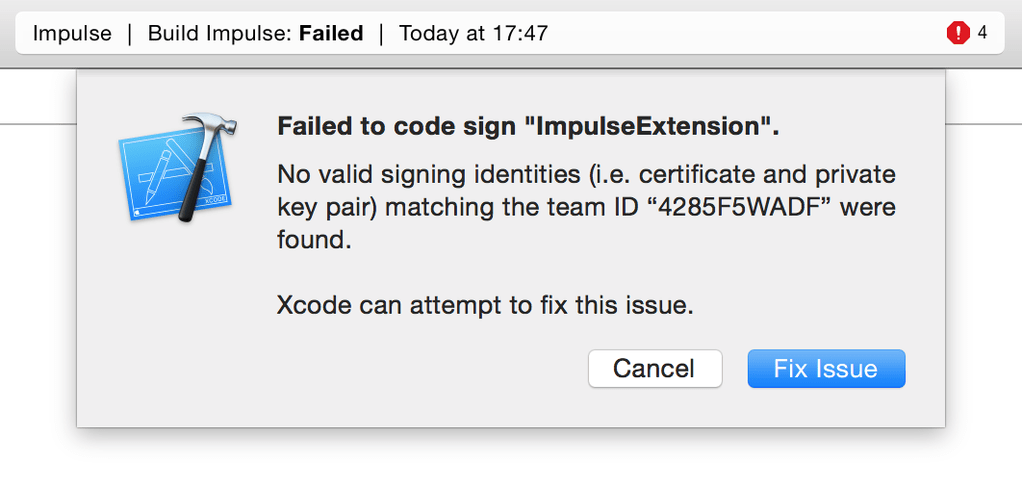
To solve this, you can share one code signing identity with your team to simplify your setup, but here’s the catch: there’s no simple way to keep the profiles and keys between the various machines in sync . You would have to manually export those keys using Xcode and transfer them between the machines every time you change something in your app. It’s especially frustrating when all you want is to run the app on your phone to test!
This is why we rethought a whole new declarative approach to solve this, with match.
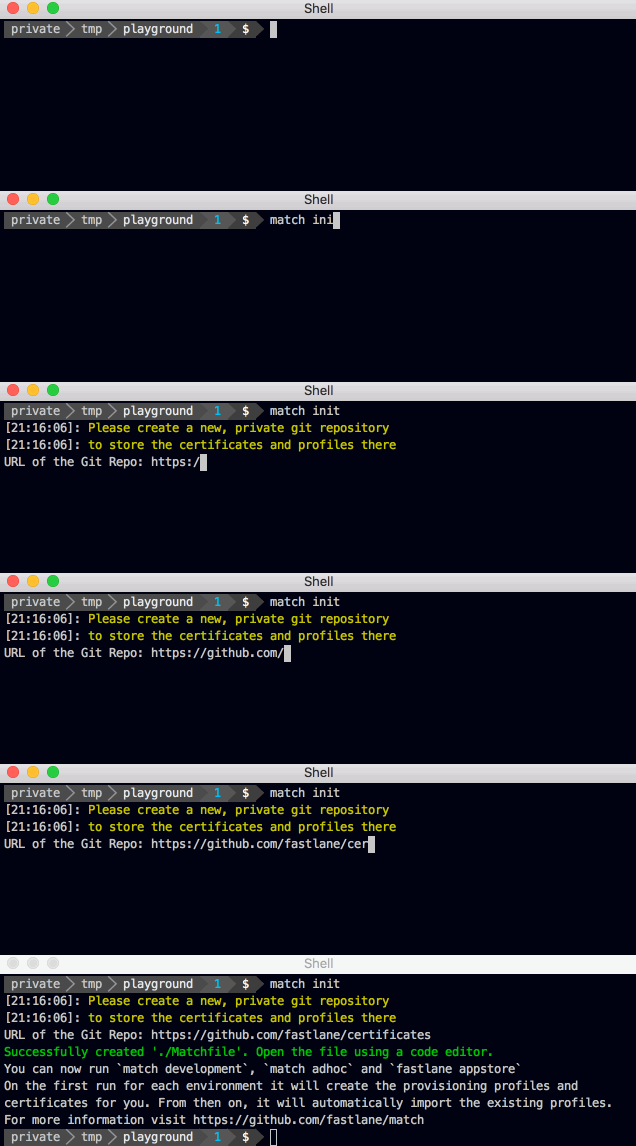
Once you create your own private Git repo, your certificates and profiles are stored there so you can have one code signing identity for the whole team. When you run fastlane, match automatically fetches the latest certificates from the remote Git repo and installs them on your local machine.
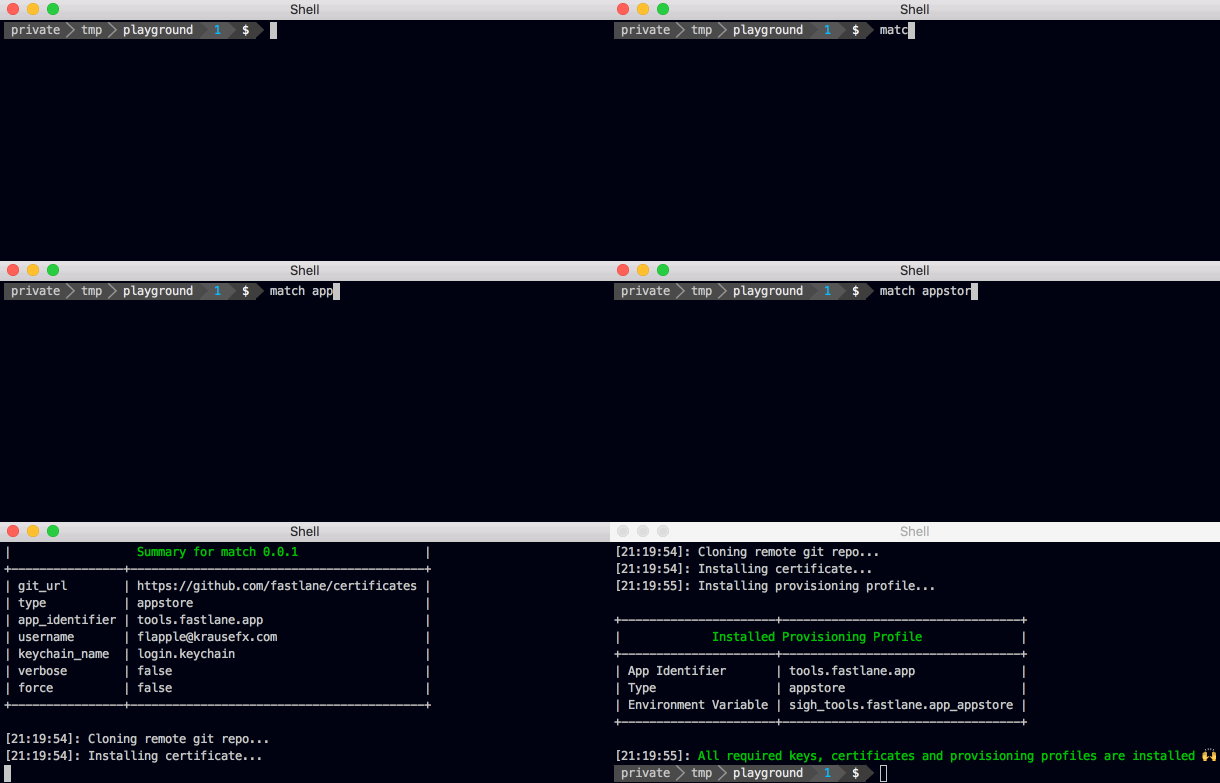
If a profile is missing, fastlane will automatically generate one for you and upload it to your Git repo.
To use match, all you have to do is specify:
- the type of the profile (App Store, Ad Hoc or Development)
- your app’s bundle identifier
Once you provide a separate, private git repo, match will store the iOS certificates provisioning profiles. Additionally, the files are encrypted using openssl.
While app development requires care throughout the deployment process, the goal for match was to make it easier to deal with the complexities of code signing when working with a team. With match, fastlane automatically pre-fills environment variables to enable proper code signing with multiple targets.
To learn more about the concept open codesigning.guide.
To get access to the source code and more technical information, visit the GitHub repo.
Open on GitHub
Introducing danger.systems
Together with Orta Therox, we created the open source project danger in 2015. It’s a tool that helps you automate your code review process. It’s a Ruby gem that runs on your CI server and can be used to automate common code review tasks. It’s used by thousands of developers and has been a great success.
At this point, danger got re-written in various programming languages (JavaScript, Swift, Kotlin & Python), check out danger.systems for a full overview.
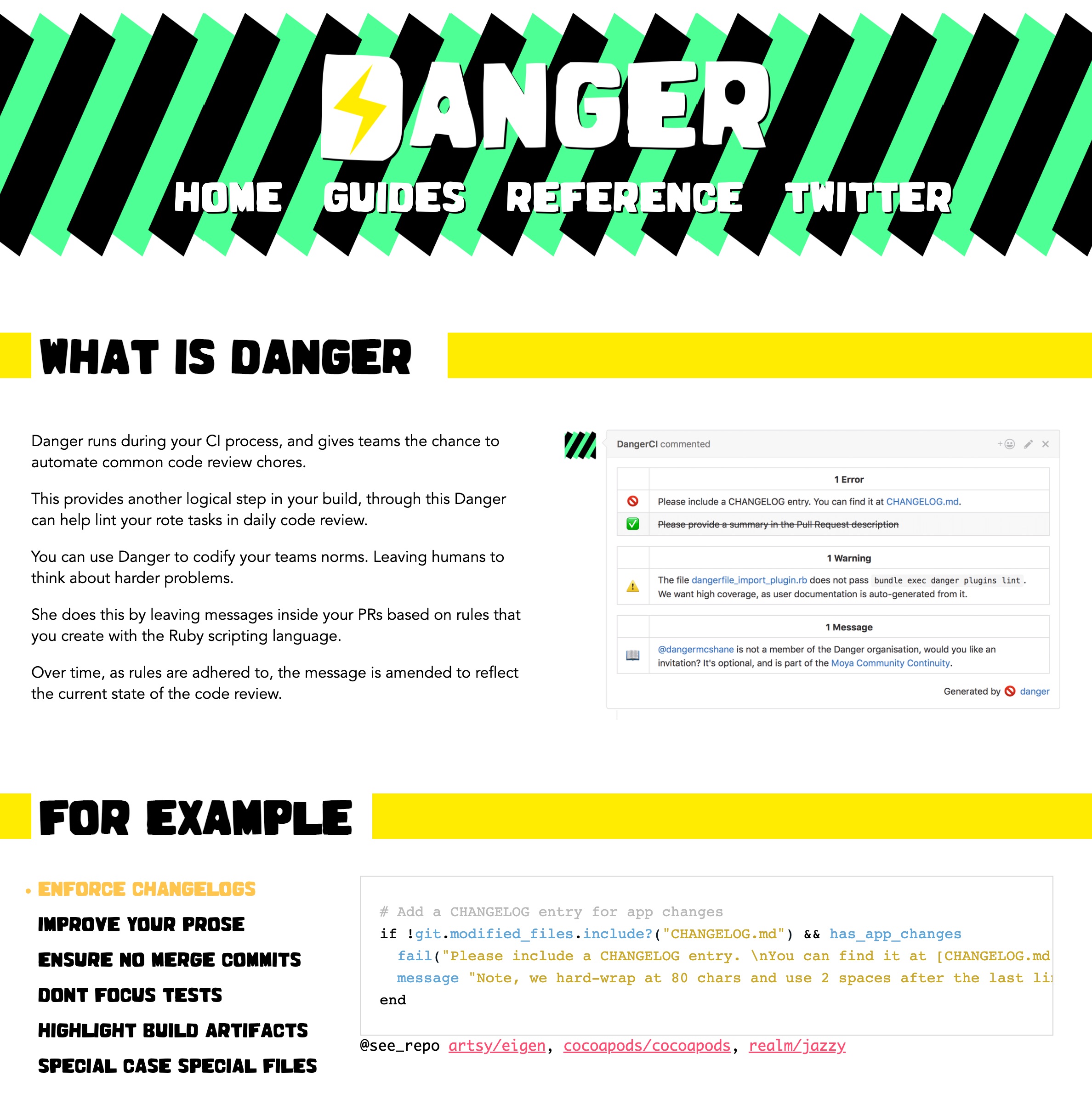
I had to stop actively working on this project in 2016, as I’ve decided to spend more of time on fastlane. To this day, @orta is still driving the project, and built an active community around it.
Tags: danger, danger.systems, opensource, github, developertool
fastlane is now part of Fabric

Update 2017: fastlane got acquired by Google
I started fastlane as a side project about a year ago. In just a short time, fastlane became the most popular iOS automation toolset, used by thousands of developers around the world. I never imagined that so many people would use it or how much time it would require to maintain it. It became a full time job!
That’s why today, I’m happy to announce that fastlane is now part of Fabric, where I will get to focus on fastlane full time and work on building the best developer tools available.
What the future holds
fastlane will stay an open source project, and I will continue to work on new features.The Fabric team is committed helping fastlane grow for both existing fastlane users and new ones.
And for the last two months, while I’ve been working from Twitter HQ in San Francisco, I was able to prepare a few big things:
1.0 Releases for all tools
In the last few weeks, I’ve been focusing a lot on quality. All fastlane tools now use spaceship to communicate with Apple. I’m very excited that all fastlane tools are now available as 1.0 releases, and I’m really looking forward to the things we’re building next.

fastlane for Android (Beta)
fastlane is the most popular Continuous Delivery solution for iOS apps. But I always wanted to make fastlane a tool that both iOS and Android developer could benefit from.
As of today, you can use fastlane for both your iOS and Android projects.Get started with fastlane for Android!

snapshot now uses UI Tests
Earlier this year Apple announced Xcode 7 with support for UI Tests. This technology allows snapshot to be even better: Instead of using UI Automation Javascript code, you can now write the screenshot code in Swift or Objective C allowing you to use the powerful debugging features built into Xcode.

New tool: scan
A lot of developers use fastlane to run tests on their project. Up until now, fastlane used third party test runners to run and monitor tests. As of today, there is a new tool called scan,making it super simple to run the tests of your iOS and Mac application.
If you’re an existing fastlane user, you can be excited about the next few weeks and what I have in the pipeline. If you’re new to fastlane, now is the best time to get started
Update 2017: fastlane got acquired by Google
Thoughts on iOS build tools
Up until now you had 2 good ways to build and sign your application from the command line:
- Use the built-in
xcodebuildcommand - Use the third party tool shenzhen
Both approaches have their problems
xcodebuild
When using xcodebuild you have to fiddle around with a long list of available parameters:
xcodebuild clean archive -archivePath build/MyApp \
                         -scheme MyApp
xcodebuild -exportArchive \
           -exportFormat ipa \
           -archivePath "build/MyApp.xcarchive" \
           -exportPath "build/MyApp.ipa" \
           -exportProvisioningProfile "ProvisioningProfileName"
That’s not something you remember and just enter every time you want to build an ipa file. The command above will generate a huge amount terminal output (talking > 10MB). For every source file that gets complied xcodebuild prints out around 60 lines of information you don’t really care about:
rause/Library/Developer/Xcode/DerivedData/Example-fhlmxikmujknefgidqwqvtbatohi/Build/Intermediates/ArchiveIntermediates/Example/IntermediateBuildFilesPath/Example.build/Release-iphoneos/Example.build/Objects-normal/arm64/main.o Example/main.m normal arm64 objective-c com.apple.compilers.llvm.clang.1_0.compiler
    cd /Users/felixkrause/Developer/fastlane/gym/example/cocoapods
    export LANG=en_US.US-ASCII
    export PATH="/Applications/Xcode-beta.app/Contents/Developer/Platforms/iPhoneOS.platform/Developer/usr/bin:/Applications/Xcode-beta.app/Contents/Developer/usr/bin:/Users/felixkrause/.rvm/gems/ruby-2.2.0/bin:/Users/felixkrause/.rvm/gems/ruby-2.2.0@global/bin:/Users/felixkrause/.rvm/rubies/ruby-2.2.0/bin:/Users/felixkrause/.rvm/bin:/usr/local/heroku/bin:/usr/local/bin:/usr/bin:/bin:/usr/sbin:/sbin"
    /Applications/Xcode-beta.app/Contents/Developer/Toolchains/XcodeDefault.xctoolchain/usr/bin/clang -x objective-c -arch arm64 -fmessage-length=126 -fdiagnostics-show-note-include-stack -fmacro-backtrace-limit=0 -fcolor-diagnostics -std=gnu99 -fobjc-arc -fmodules -gmodules -fmodules-cache-path=/Users/felixkrause/Library/Developer/Xcode/DerivedData/ModuleCache -fmodules-prune-interval=86400 -fmodules-prune-after=345600 -fbuild-session-file=/Users/felixkrause/Library/Developer/Xcode/DerivedData/ModuleCache/Session.modulevalidation -fmodules-validate-once-per-build-session -Wnon-modular-include-in-framework-module -Werror=non-modular-include-in-framework-module -Wno-trigraphs -fpascal-strings -Os -fno-common -Wno-missing-field-initializers -Wno-missing-prototypes -Werror=return-type -Wunreachable-code -Wno-implicit-atomic-properties -Werror=deprecated-objc-isa-usage -Werror=objc-root-class -Wno-arc-repeated-use-of-weak -Wduplicate-method-match -Wno-missing-braces -Wparentheses -Wswitch -Wunused-function -Wno-unused-label -Wno-unused-parameter -Wunused-variable -Wunused-value -Wempty-body -Wconditional-uninitialized -Wno-unknown-pragmas -Wno-shadow -Wno-four-char-constants -Wno-conversion -Wconstant-conversion -Wint-conversion -Wbool-conversion -Wenum-conversion -Wshorten-64-to-32 -Wpointer-sign -Wno-newline-eof -Wno-selector -Wno-strict-selector-match -Wundeclared-selector -Wno-deprecated-implementations -DCOCOAPODS=1 -DNS_BLOCK_ASSERTIONS=1 -DOBJC_OLD_DISPATCH_PROTOTYPES=0 -isysroot /Applications/Xcode-beta.app/Contents/Developer/Platforms/iPhoneOS.platform/Developer/SDKs/iPhoneOS9.0.sdk -fstrict-aliasing -Wprotocol -Wdeprecated-declarations -miphoneos-version-min=9.0 -g -fvisibility=hidden -Wno-sign-conversion -fembed-bitcode -iquote /Users/felixkrause/Library/Developer/Xcode/DerivedData/Example-fhlmxikmujknefgidqwqvtbatohi/Build/Intermediates/ArchiveIntermediates/Example/IntermediateBuildFilesPath/Example.build/Release-iphoneos/Example.build/ExampleProductName-generated-files.hmap -I/Users/felixkrause/Library/Developer/Xcode/DerivedData/Example-fhlmxikmujknefgidqwqvtbatohi/Build/Intermediates/ArchiveIntermediates/Example/IntermediateBuildFilesPath/Example.build/Release-iphoneos/Example.build/ExampleProductName-own-target-headers.hmap -I/Users/felixkrause/Library/Developer/Xcode/DerivedData/Example-fhlmxikmujknefgidqwqvtbatohi/Build/Intermediates/ArchiveIntermediates/Example/IntermediateBuildFilesPath/Example.build/Release-iphoneos/Example.build/ExampleProductName-all-target-headers.hmap -iquote /Users/felixkrause/Library/Developer/Xcode/DerivedData/Example-fhlmxikmujknefgidqwqvtbatohi/Build/Intermediates/ArchiveIntermediates/Example/IntermediateBuildFilesPath/Example.build/Release-iphoneos/Example.build/ExampleProductName-project-headers.hmap -I/Users/felixkrause/Library/Developer/Xcode/DerivedData/Example-fhlmxikmujknefgidqwqvtbatohi/Build/Intermediates/ArchiveIntermediates/Example/BuildProductsPath/Release-iphoneos/include -I/Users/felixkrause/Developer/fastlane/gym/example/cocoapods/Pods/Headers/Public -I/Users/felixkrause/Developer/fastlane/gym/example/cocoapods/Pods/Headers/Public/HexColors -I/Users/felixkrause/Library/Developer/Xcode/DerivedData/Example-fhlmxikmujknefgidqwqvtbatohi/Build/Intermediates/ArchiveIntermediates/Example/IntermediateBuildFilesPath/Example.build/Release-iphoneos/Example.build/DerivedSources/arm64 -I/Users/felixkrause/Library/Developer/Xcode/DerivedData/Example-fhlmxikmujknefgidqwqvtbatohi/Build/Intermediates/ArchiveIntermediates/Example/IntermediateBuildFilesPath/Example.build/Release-iphoneos/Example.build/DerivedSources -F/Users/felixkrause/Library/Developer/Xcode/DerivedData/Example-fhlmxikmujknefgidqwqvtbatohi/Build/Intermediates/ArchiveIntermediates/Example/BuildProductsPath/Release-iphoneos -isystem /Users/felixkrause/Developer/fastlane/gym/example/cocoapods/Pods/Headers/Public -isystem /Users/felixkrause/Developer/fastlane/gym/example/cocoapods/Pods/Headers/Public/HexColors -MMD -MT dependencies -MF /Users/felixkrause/Library/Developer/Xcode/DerivedData/Example-fhlmxikmujknefgidqwqvtbatohi/Build/Intermediates/ArchiveIntermediates/Example/IntermediateBuildFilesPath/Example.build/Release-iphoneos/Example.build/Objects-normal/arm64/main.d --serialize-diagnostics /Users/felixkrause/Library/Developer/Xcode/DerivedData/Example-fhlmxikmujknefgidqwqvtbatohi/Build/Intermediates/ArchiveIntermediates/Example/IntermediateBuildFilesPath/Example.build/Release-iphoneos/Example.build/Objects-normal/arm64/main.dia -c /Users/felixkrause/Developer/fastlane/gym/example/cocoapods/Example/main.m -o /Users/felixkrause/Library/Developer/Xcode/DerivedData/Example-fhlmxikmujknefgidqwqvtbatohi/Build/Intermediates/ArchiveIntermediates/Example/IntermediateBuildFilesPath/Example.build/Release-iphoneos/Example.build/Objects-normal/arm64/main.o
The best way to fix the output annoyance is to use xcpretty in which you can pipe the xcodebuild ouput.
shenzhen
shenzhen was the easiest way to build your iOS application: It took care of generating the xcodebuild commands to build your application. But instead of showing a clean output while building, it omitted the complete output of the whole process.
The main issue with shenzhen was the information you received when you run into an error:
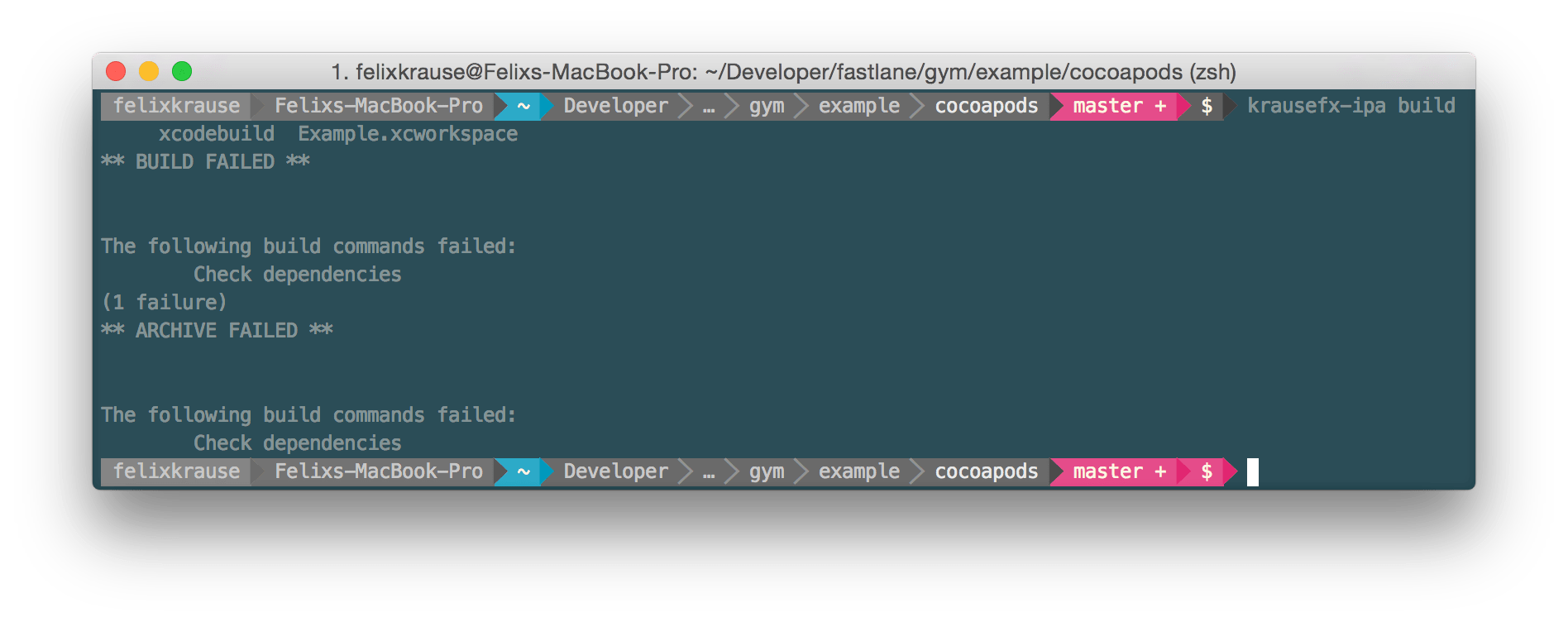
You know what you’d need to do to solve this issue? No, it’s not clear, you don’t get any information that helps you fix this issue. That’s a simple code signing issue, in which the project defines a provisioning profiles that doesn’t exist.
shenzhen is a great tool, but hasn’t received any updates recently. With fastlane I used a fork of shenzhen to fix some bugs. After a time I decided to build ‘gym’, a tool which should replace the building part of shenzhen.(shenzhen also does distribution to beta testing services)
Improving the process
In my opinion it’s really important a tool does different things depending on the outcome:
- When the tool succeeded, the user doesn’t need a lot of output/information, except that everything worked fine
- When something went wrong while building, the user should get as much relevant information as possible to make it easy to quickly fix the issue.
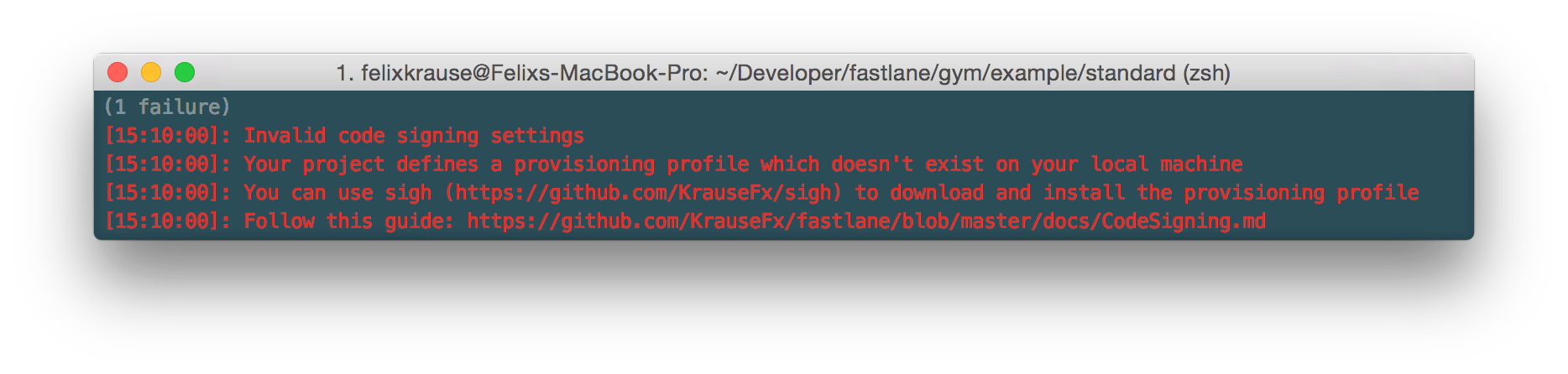
Tools should actively help the user resolve common issues. By showing as much useful information as possible and even telling the user how to fix it, a tool automatically becomes much more useful.
Tools can automatically detect all kinds of issues and help the user fix them really fast:
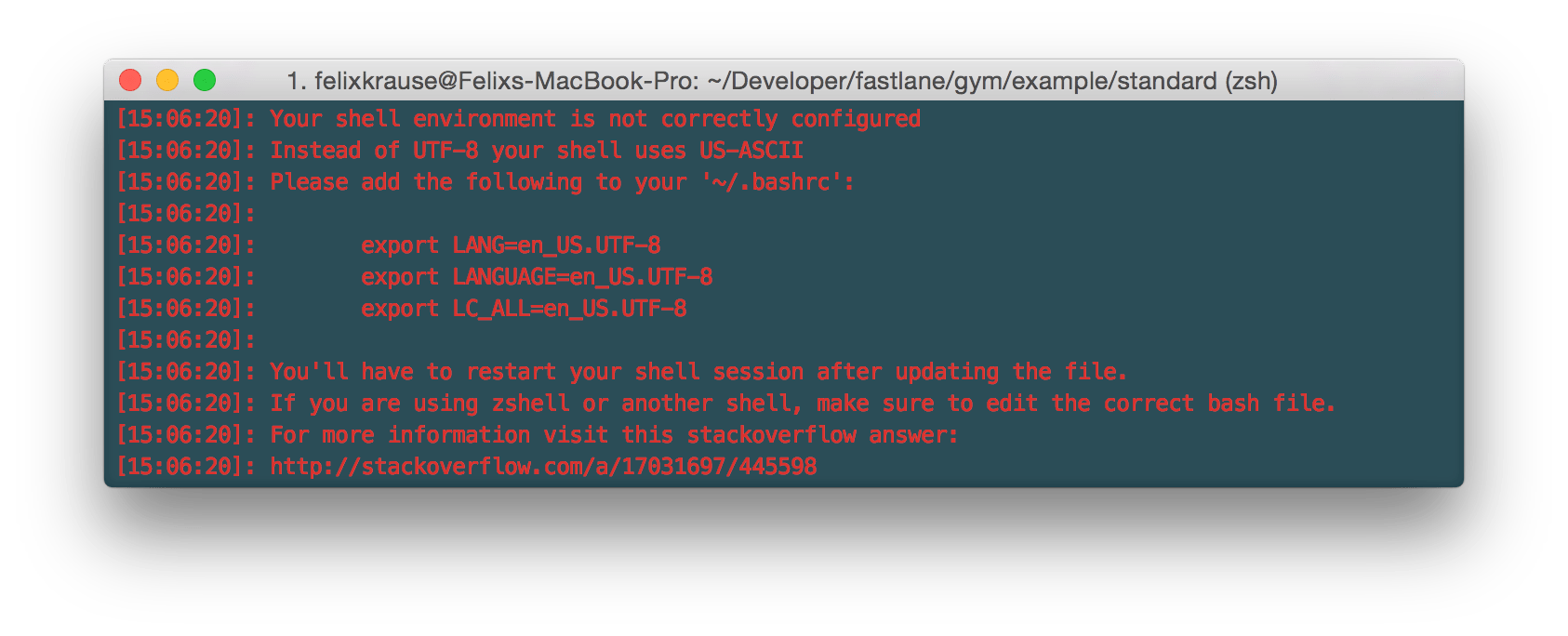
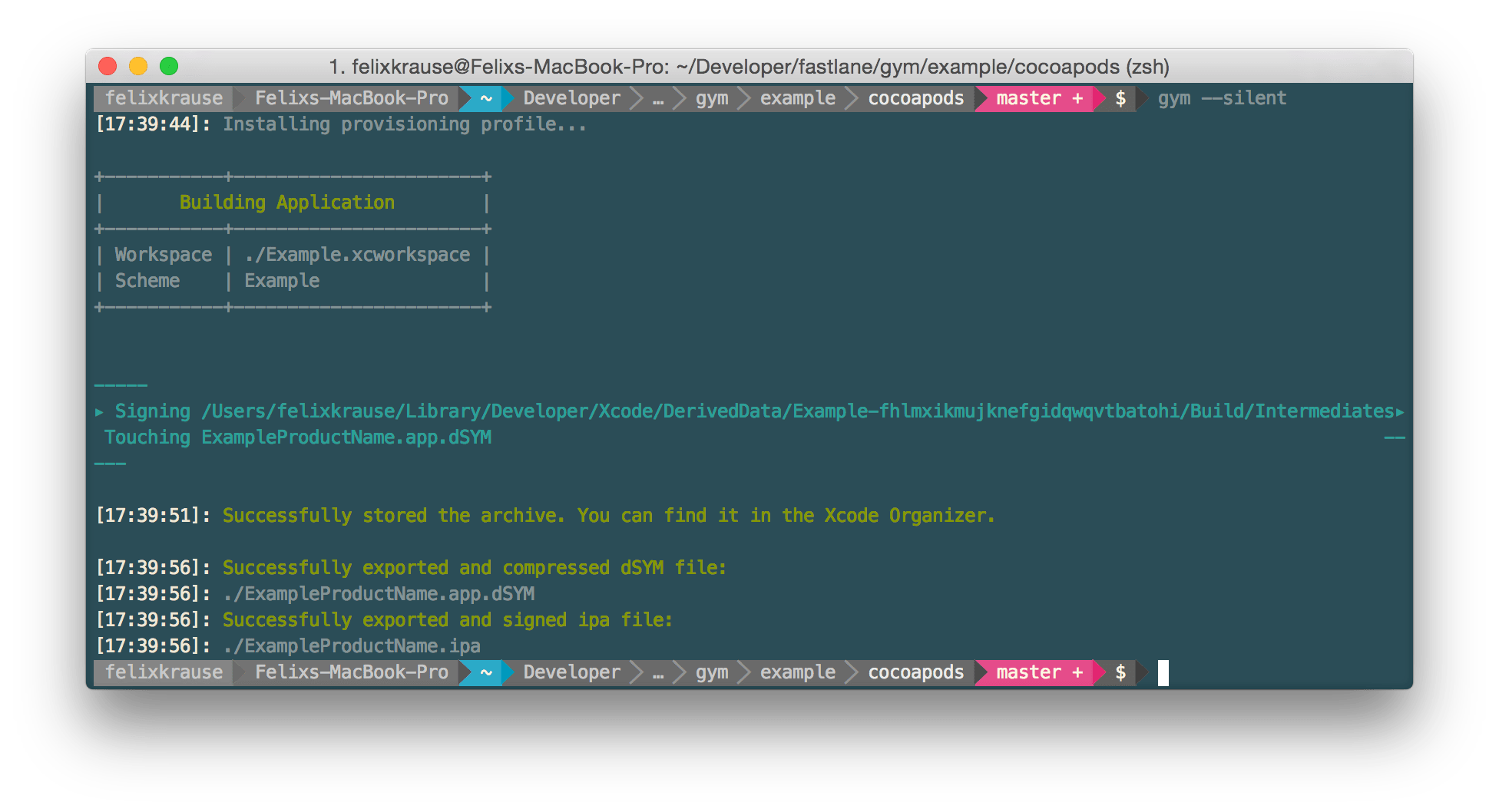
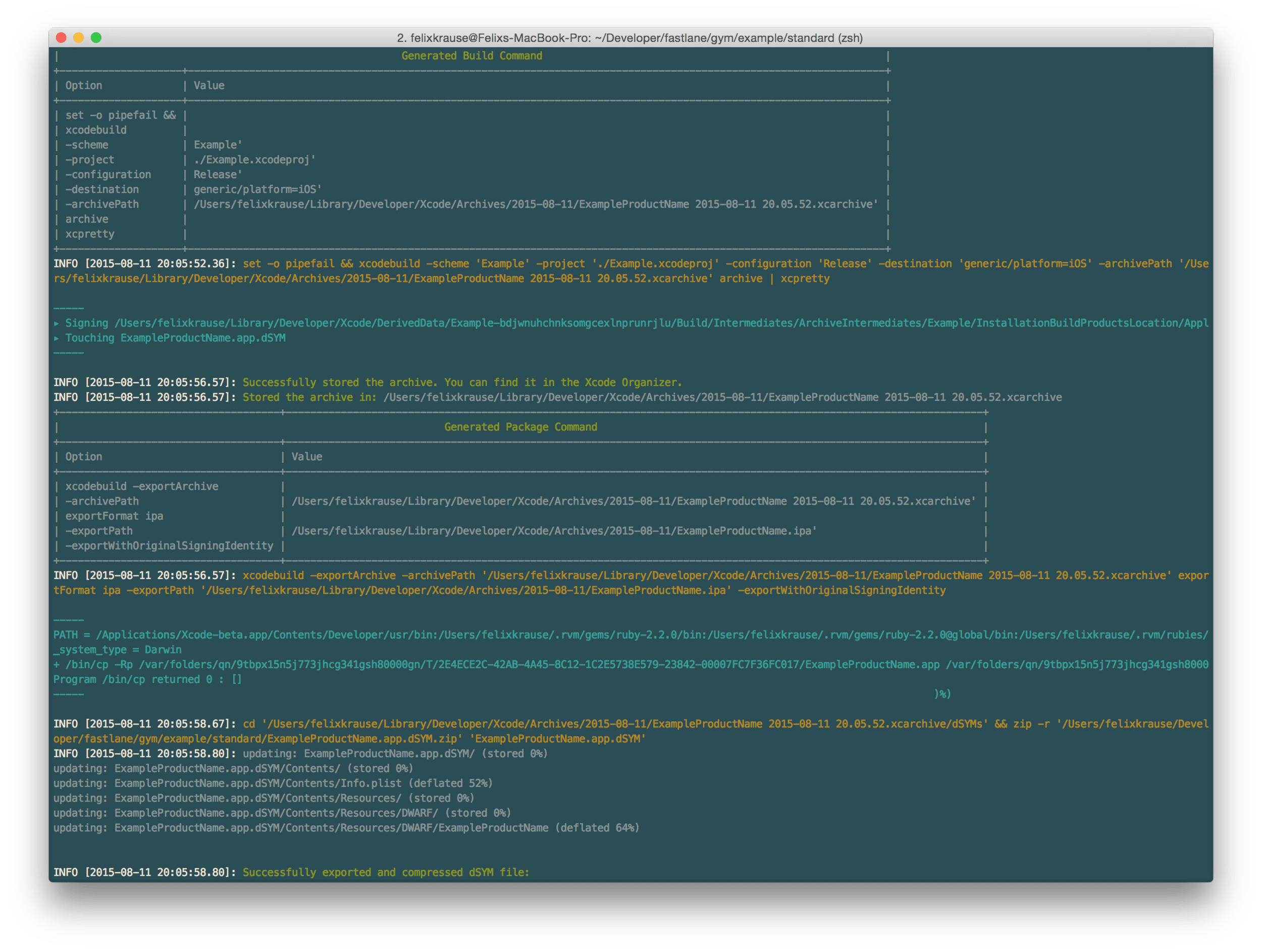
When gym succeeds the terminal output is minimalistic but still shows relevant and useful information while processing
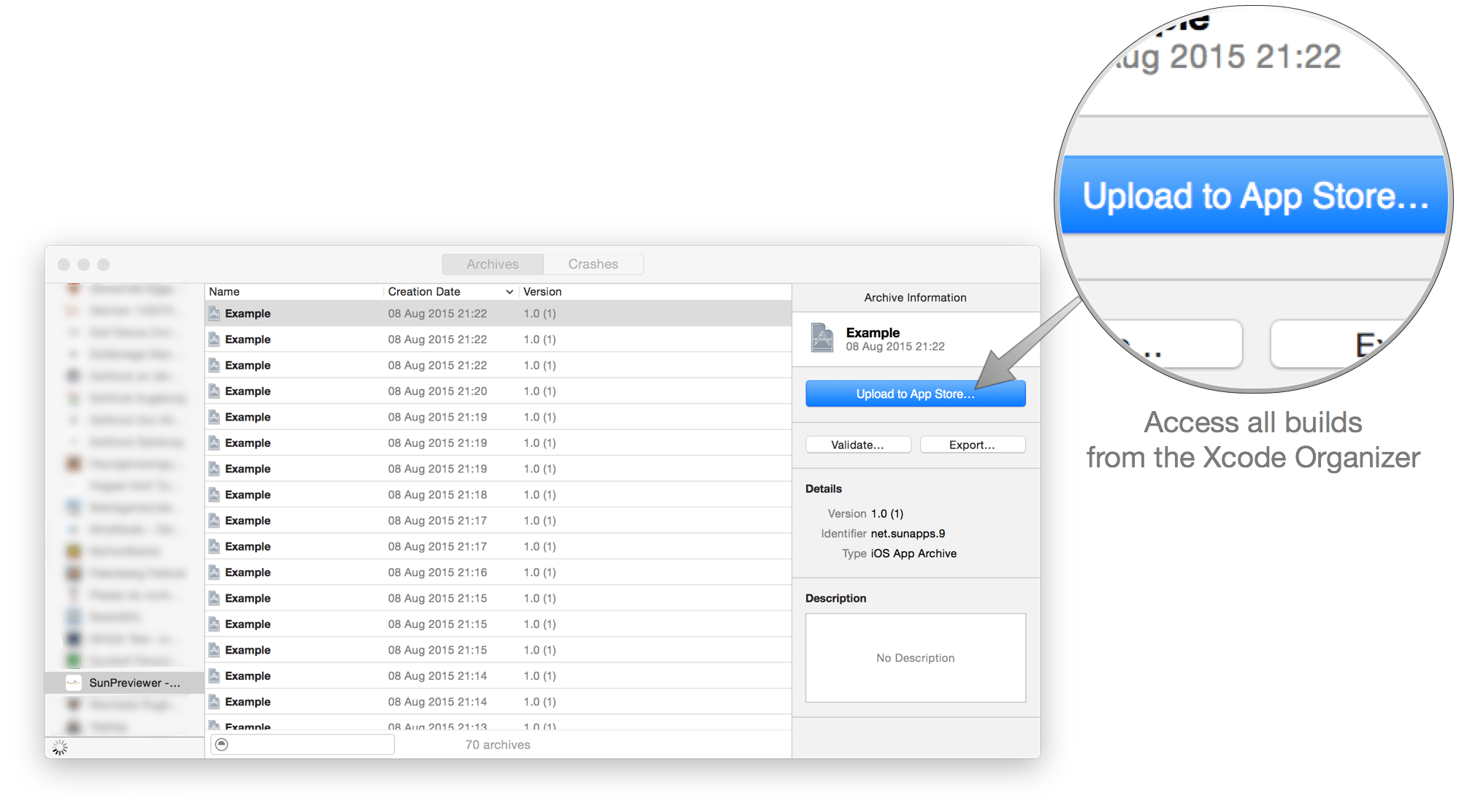
Another important point is being compatible with existing technologies. With gym for example I want the user to still be able to use the Xcode Organiser to distribute the archive or dSYM file
Information
When writing about developer tools I don’t want to forget the famous “Fix Issue” button.
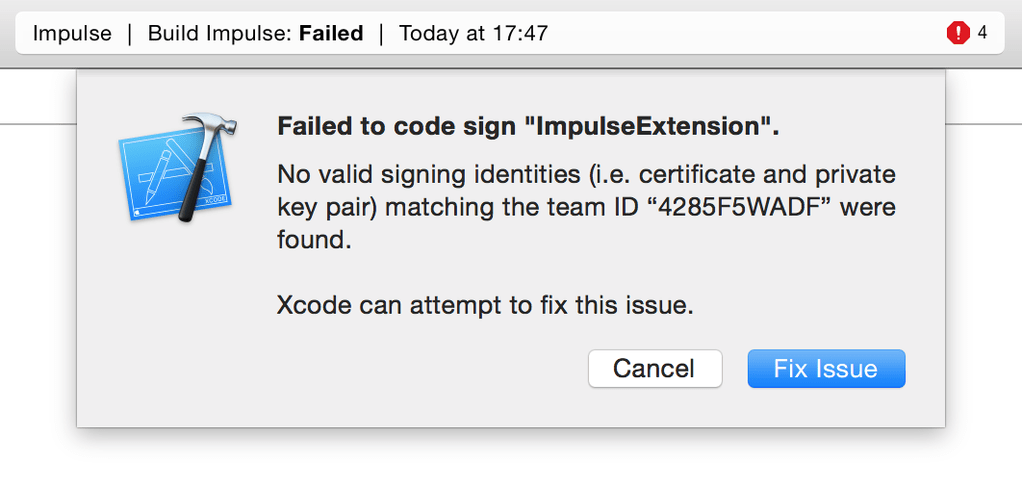
How can we improve it?
The most important things a developer tool should do
- Expose information about what Xcode is going to try when you click “Fix Issue”
- Show a log of what was tried and what failed
- If possible show the user how to fix an issue manually
In the example of gym you get every shell command that is being executed printed out so you can manually try fixing something in case the build process fails.
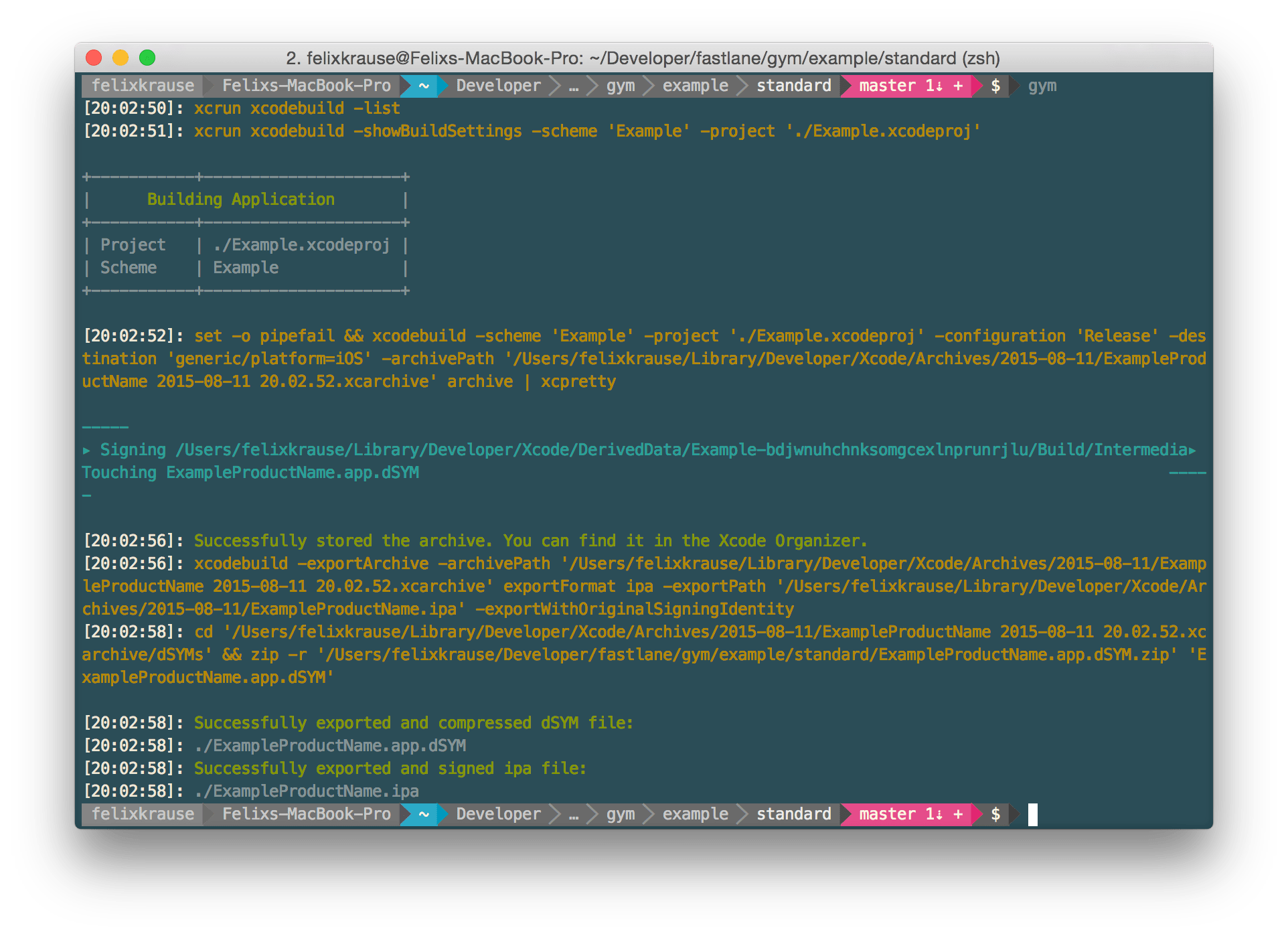
If you need even more information, the you can use --verbose flag.
Conclusion
Besides standard features like sensible defaults and convention over configuration, I think it’s important the user knows what’s going on with the tool. This allows the users to debug issues themselves. By being transparent you build up trust. Developer see what the tool is doing.
You can check out gym on GitHub: https://github.com/fastlane/gym